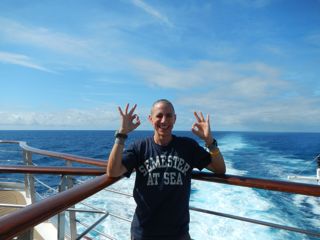
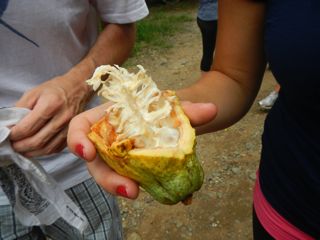
The MV Explorer just spent the past four days docked in the port of Tema in the Republic of Ghana. Built on what used to be a small fishing village, the town was commissioned by Ghana’s first president, Kwame Nkrumah, and now handles 80% of Ghana’s imports and exports, including their largest export, cocoa. I actually got to try a cocoa bean right from the pod. The bean is covered with a very sweet pulp, but I made the mistake of biting into the bean, thinking it would be sweet, too. Of course, every kid who has tried cocoa powder can tell you that it definitely is not. Plantains, however, while not as sweet as the cavendish bananas we typically eat in the United States, taste great with no processing, and Ghana is the second largest producer of plantains in the world.

Another interesting fact about Tema is that the Prime Meridian, or the navigational line marking 0º0’ (zero degrees, zero minutes) longitude, runs right through it. There is actually a Church of the Prime Meridian, where you can straddle the line.
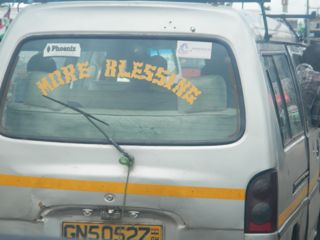
My first day in Ghana, however, involved more of the capital city, Accra, located sixteen miles west of Tema. Traffic is so intense, it took one and a half hours to reach it by bus. Most people, if they don’t have a car or motorcycle, get around in vans or minibuses called trotros, which wait until they are packed with people to leave for pre-arranged destinations. There are also lots of taxis, but no meters so definitely agree on a price before getting inside.
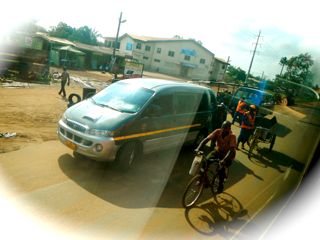

Once we reached Accra, we took a taxi to the National Cultural Market, where over a hundred vendors fronted stalls with the invitation to step inside, saying “It’s free to look.” Sure, I thought, but how much will it cost to get out? I’m a terrible shopper, but I really like people so I talked to many of the vendors and craftspeople, especially toward the rear of the market, where better bargains could be found. No item has a tag. You are expected to negotiate for a fair price with the vendor, and when you agree, you pay for the item in cedi (pronounced SEE-dee).
I had very little money with me, but I was taken around to many of the stalls and introduced, which is how I learned that one of my Ghanaian names--in the Twi language--would be Kofi, an Akan name given because I was born on a Friday and perceived by almost all the Ghanaians I met to be male. Because of this, I had a different experience than I might otherwise have had, especially since many of the females received multiple serious marriage proposals. While I heard reports from shipmates who were either exhausted or overwhelmed by the persistence of the vendors--who followed you out of their stalls, cajoling you to buy--I actually had a great time walking around interacting with people.
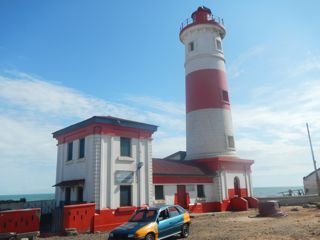
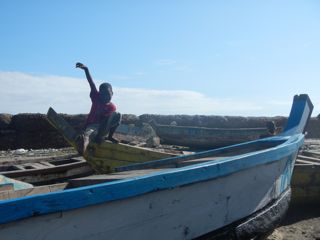
After the market, a small group of us walked south in search of lunch, which we never did find. Instead, we walked on High Street, passing through Ussherstown, where we briefly entered Ussher Fort, and continuing on to Jamestown. These are the oldest districts in Accra and both are low-income fishing communities with a population consisting largely of people from the Ga ethnic group. We had intended to see the Accra Light, a 93-foot lighthouse, but when we got there, a man claiming to be the lighthouse watchman was fully prepared to charge us for the grand tour. We decided against it, and he then asked if we wanted to walk down to the shanty town that sloped toward the beach. I could try to explain what I saw that afternoon--people trying to survive as best they could without electricity, running water, or much of a way to make a living--but those descriptions would be what you’d expect in such conditions. What I wanted to share more was the pride with which our unofficial guide showed us each part of the village, introducing us to people along the way, showing and telling us the history of the area, including James Fort, a trading post built by the British in 1673. In addition, there were two boys who took my hands and showed me a bit of the world through their eyes.



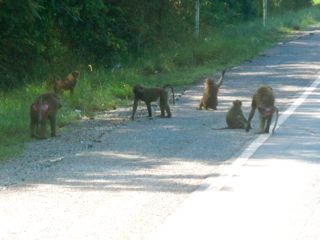
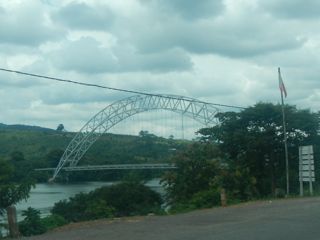
On the second day, we left the ship early on a bus to the Volta Region, located east of Volta Lake, which if you measure by surface area is the largest reservoir in the world at 3,275 square feet. The largest ethnic group in the area is the Ewe, originating from the neighboring country of Togo. This was going to be an incredibly full day and we started off not too far into the journey by seeing baboons in the street, presumably in search of water. Too bad we weren’t yet near Volta Lake, over which lay the incredibly interesting Adome Bridge below. Correct me if I’m wrong: does that baboon look like he’s waving?
We traversed many of the 18 districts of the Volta Region that day, at one point driving several miles on roads I never thought a minibus could maneuver. Fortunately, our driver that day was amazing, bringing us safely to many destinations, the first of which was four and a half hours from our start: an area from which we could climb Afadjato, the highest point in Ghana. Many people mistakenly call this Mount Afadjato, but our guide told us that Afadjato already includes the word for mountain in it.
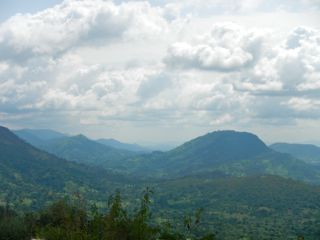
At 2,904 feet and with few switchbacks, it made for a steep climb, which of course, was well worth it. We could see Tagbo Falls on one side and green hills all around. As you can see, our guides to the top were young men, who barely broke a sweat and did the climb in flip flops. All except two of our group made it up, but it required a lot of stamina, balance, and determination. I completed the climb directly behind our 14-year-old guide--who wasn’t by any means going his fastest--but that may have been sheer stubbornness on my part more than anything else.
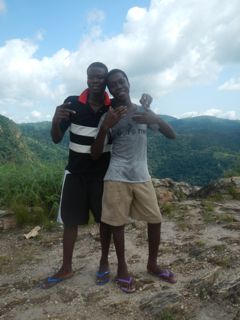
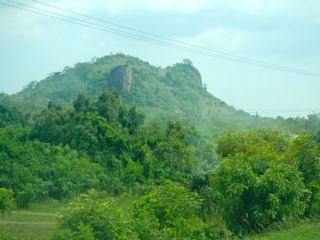
The first view below is of the mountain itself and the rest were taken at the top.


After lunch, which we ate on the bus, we arrived at the information center for Wli Falls, the highest in all of West Africa. We hiked about 45 minutes through the Agumatsa Forest Reserve, on mostly level ground, crossing the same river ten times, to reach the lower portion of the waterfall. Since the water falls about 1,600 feet, we all got soaked, even those who decided not to wade into the plunge pool at the base. I did, and the force of the spray felt amazing. Thank you to the woman who took the photo of me!


After the hike out from Wli Falls, we drove to Tafi Atome, a small village in the Volta Region, where we ate dinner around a long table. The dinner involved a red sauce that contained hard boiled eggs. We were told that eggs are a special dish and instructed not to take more than one. The red sauce was amazing. It was a type of spaghetti sauce, but the ingredients also included fresh ginger and chili pepper. After dinner, we sat around an outdoor fire in front of St. Francis of Asissi Church, while members of the community sang, drummed, and danced. We joined the dancing toward the end, moving as a group in a circle around the fire.
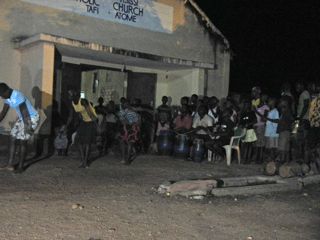
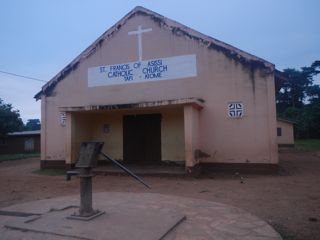
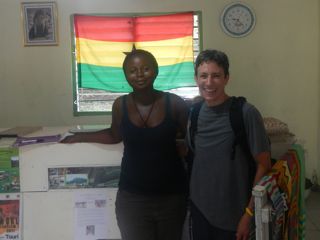
We stayed overnight in the village, some people sleeping in a guest house and the rest of us in homes. Our host was a woman named Gladys, who worked at the Mona Monkey Sanctuary.

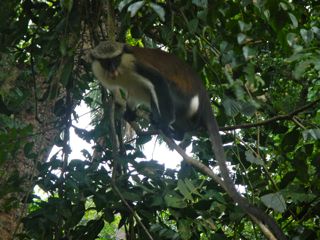
Tafi Atome is home to four troops of mona monkeys. The people in the village consider the mona monkeys to be sacred and have a wooded sanctuary dedicated to their survival. Currently, there are close to 200 mona monkeys in the sanctuary. The next morning at 6 AM, we saw about twenty of them. One jumped on my shoulder, snatched a banana, and hopped back into the tree to eat it. Another one actually sat on Mary’s arm to enjoy the treat.

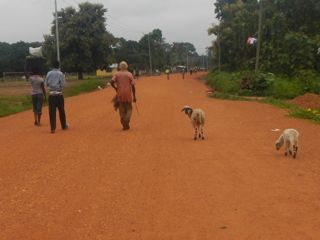
We then had our breakfast, which included bananas, just like the monkeys, and afterwards, we walked around the village, meeting people--and also many goats--who lived there, before heading back to Tema.


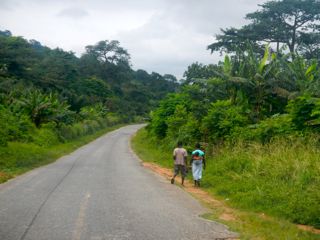
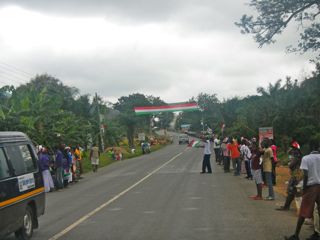
On the way to lunch, we passed through streets lined with people. Our bus driver and guide both realized that the President of Ghana, John Dramani Mahama, who succeeded John Atta Mills this past July, when Atta Mills died unexpectedly. We saw a row of unmarked black SUVs with sirens drive by. One of them held the President. Though his car is usually marked with an insignia, it was covered, not for secrecy but because he is currently campaigning. Democratic elections will be held in two rounds in December.

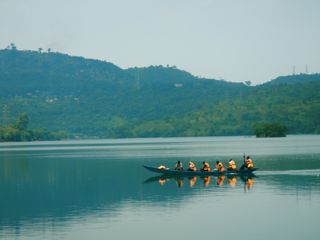
We had lunch that afternoon at Akwaabi Restaurant, on the grounds of the Afrikiko, a wonderful lodge overlooking a lake.


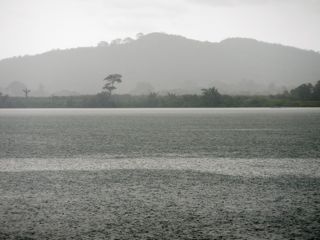
Just as we finished lunch, a rainstorm came through. The first photo below looks like it was taken in black-and-white. It was not. Hard rains, and just before they ended, we made our way to the bus for the very green return trip to Tema.


The next day, our final in Ghana, I went to the village of Torgome, located along the lower Volta River. We paid our respects to the paramount chief and queen mother of the village. Seated in the very front, however, were the male and female linguists. I asked how they were chosen and learned that the linguists are the people who are best able to communicate the customs and traditions of the village and the reason they sit in front of all the others is because if you want to speak either to the chief or queen mother, you needed to go through them first.
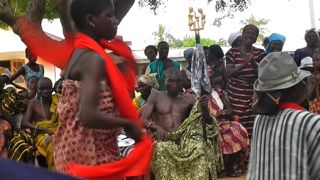
We were encouraged to dance with the people from the village even before any of the ceremony began. I love to dance and twice, an elder woman wrapped me with kente cloth while we danced. When it came time for my village name to be given, they announced me as the best dancer, and as I walked around the village later, some of the children and even adults began dancing when they saw me. The kids especially were imitating my moves. It was a form of acceptance and welcome into their community, and I treasure it. Thanks to Meaghan Patrick for the shots of me in action and to Megan Drew for the naming line-up shot further down.


Everything in Ghanaian culture is infused with meaning. Masks, cloths, paintings, drums, everything. The cloth they wrapped around me was black and white, and when I looked up the significance of these colors, I found that black signifies maturation and intensified spiritual energy while white signifies sanctification rites and festive occasions.
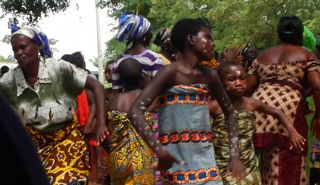
The naming ceremony in which we took part is one that is believed to lead you to your destiny. Ghanaians often have several names, and although the ceremony is typically done for newborns, we were each to receive a name, a bracelet, and a pot made by the elder women of Torgome with our given and new names painted on it. I had a very interesting experience. I wasn’t sure how I was being perceived, but I was about to find out.
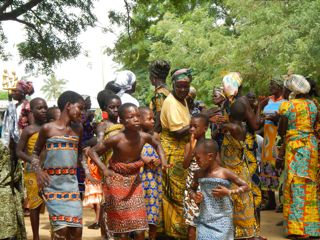
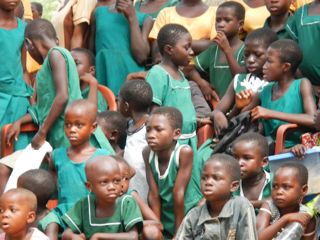
The ceremony began with prayer and the pouring of libations to invite the ancestors to partake with us. First, alcohol was poured on the ground but then because alcohol is considered to generate heat, water is also poured over it to cool any anger that the ancestors might bring with them when summoned.
We stood in lines as our given names were announced and we were told and then asked to speak our new Ghanaian names. The first name is based on your sex and the day on which you were born. As mentioned earlier, my first name was Kofi. My second name was Fafanyo, which I believe means Peace. I can’t believe I forgot the exact meaning, but there was a lot going on that day. An elder woman tied my beaded bracelet on. I wasn’t sure what hand to raise because they put the bracelet on the right hand for a male and the left hand for a female. When I tentatively raised my left hand, the elder slapped it down--twice--and grabbed my right hand, putting the bracelet around that wrist. So that was that.

We then saw a demonstration of how the elder women make the pots, which is their only form of livelihood. They sell the pots for only as much as a couple dollars per pot, but you can guess the price tag that distributors place on them. The younger women don’t want to make the pots until they are older because it is backbreaking labor. The women bend at the waist, as they make the clay pots on the ground, in the same way they’ve been made for hundreds of years. It was amazing to watch. I have no photos because two young boys had hold of my hands the entire time, but I do have a photo of my bracelet and the pot!
That more or less wrapped up my time in Ghana. I feel like I’ll need a long time to process the experience. That won’t happen right away, however, because tomorrow is Neptune Day. I’m going through another renaming. More on that to follow!
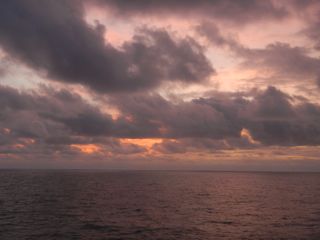
Fortunately, I’ll have some time to process since we have a six-day ride to our next destination: Cape Town, South Africa. In reality, it will take me a lot longer than that to appreciate the new experiences I had in the Accra and Volta Regions of the Republic of Ghana.